
Physical Pharmacy (1st Semester of Pharm D) (Written)
- DOCTOR OF PHARMACY (PHARM-D), Pharm-D Semester-I
- 130 (Registered)
-
(0 Review)
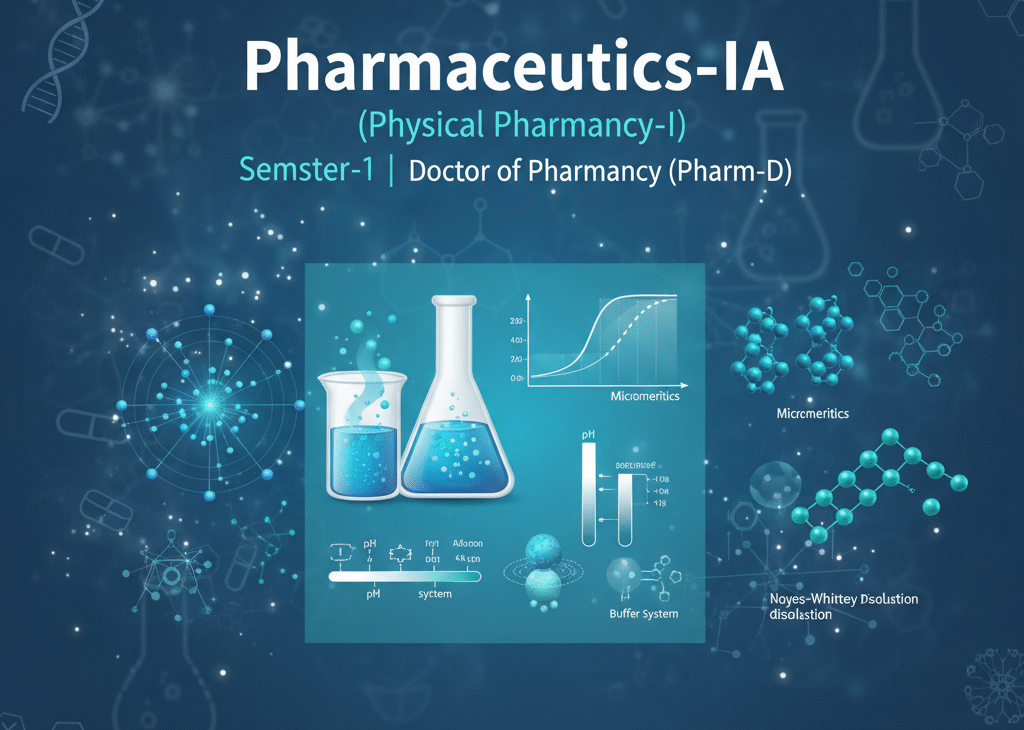

Physical Pharmacy- Doctor of Pharmacy – First Semester
The first semester of the Pharm D program lays a strong foundation in both basic and pharmaceutical sciences, integrating theoretical and practical knowledge essential for future clinical practice.
Theory Subjects:
Pharmaceutics-I (Physical Pharmacy)
Course Learning Outcomes:
At the end of this course the student will be able to:
1. Describe the historical evolution of pharmacy through ancient Greek, Arab, and Muslim
contributions and the significance of official compendia and texts.
2. Explain basic physicochemical principles relevant to drug delivery systems and formulations.
Contents:
1. Introduction to Pharmacy and History:
i. Introduction and orientation to the Pharmacy Profession with the current scope and latest applications.
ii. A survey of the history of pharmacy through ancient, Greek, and Arab periods with special reference to the contribution of Muslim scientists to pharmacy and allied sciences.
iii. The Industrial Revolution and the development of Pharmaceuticals in the 20th century.
iv. The developments in the 21st century, especially with reference to Biotechnology, nanotechnology, and artificial intelligence.
2. Introduction to Pharmaceutical Literature: Introduction to the scientific literature, literature types in pharmacy, official texts and compendia, and their significance.
3. Introductory concepts in Physical Pharmacy: i. Fundamentals and overview of the concepts of physicochemical properties and their application in product development.
ii. Basic concepts of physical pharmacy in dosage forms science and its various applications.
4. Physico-Chemical Principles:
i. Solutions: Types, concentration expressions, ideal and real solutions, colligative properties, and applications in pharmacy.
ii. Solubility and Solubilization: Definition and concepts of solubility and Solubilization,
mechanism, factors affecting solubility and solubilization.
iii. Dissolution and Permeation: Definition and concepts, types, Factors affecting dissolution and permeation, Noyes-Whitney equation
iv. Polymorphism: Basic concept, lattice structure, and significance in pharmaceuticals. Amorphous and crystalline solids and their effect on thermodynamics. Role in dissolution.
5. Ionization and Buffers:
i. Strong vs. Weak Electrolytes, pH, pKa, and buffer systems and capacity. Henderson Hasselbalch Equation and application in drug formulation.
ii. Hypo, hyper, and Isotonic solutions and pharmaceutical applications.
6. Micromeritics:
i. Particle size and its distribution, Texture and morphological characteristics of pharmaceutical powders. Role and importance in pharmacy and medicines.
ii. Methods of particle size analysis, distribution, and morphological determination (sieving,
microscopy etc.).
iii. Flow properties: Carr’s Index, Hausner’s ratio, angle of repose.
Curriculum
- 2 Sections
- 4 Lessons
- 2000 Days
- PHARMACEUTICS-I (PHYSICAL PHARMACY)1
- ENGLISH COMPULSORY (Free course, go inside and use content for your exam purpose)Enhance language skills and develop critical thinking. Enable the students to meet their real life communication needs. Enhance language skills and develop critical thinking.3
Instructor

Related Courses
 Teacher
Pharmacist Tayyeb Official
Teacher
Pharmacist Tayyeb Official
 Teacher
Pharmacist Tayyeb Official
Teacher
Pharmacist Tayyeb Official
 Teacher
Pharmacist Tayyeb Official
Teacher
Pharmacist Tayyeb Official
 Teacher
Pharmacist Tayyeb Official
Teacher
Pharmacist Tayyeb Official
 Teacher
Pharmacist Tayyeb Official
Teacher
Pharmacist Tayyeb Official
 Teacher
Pharmacist Tayyeb Official
Teacher
Pharmacist Tayyeb Official