
Physiology-I (1st Semester of Pharm D) (Written)
- DOCTOR OF PHARMACY (PHARM-D), Pharm-D Semester-I
- 119 (Registered)
-
(0 Review)
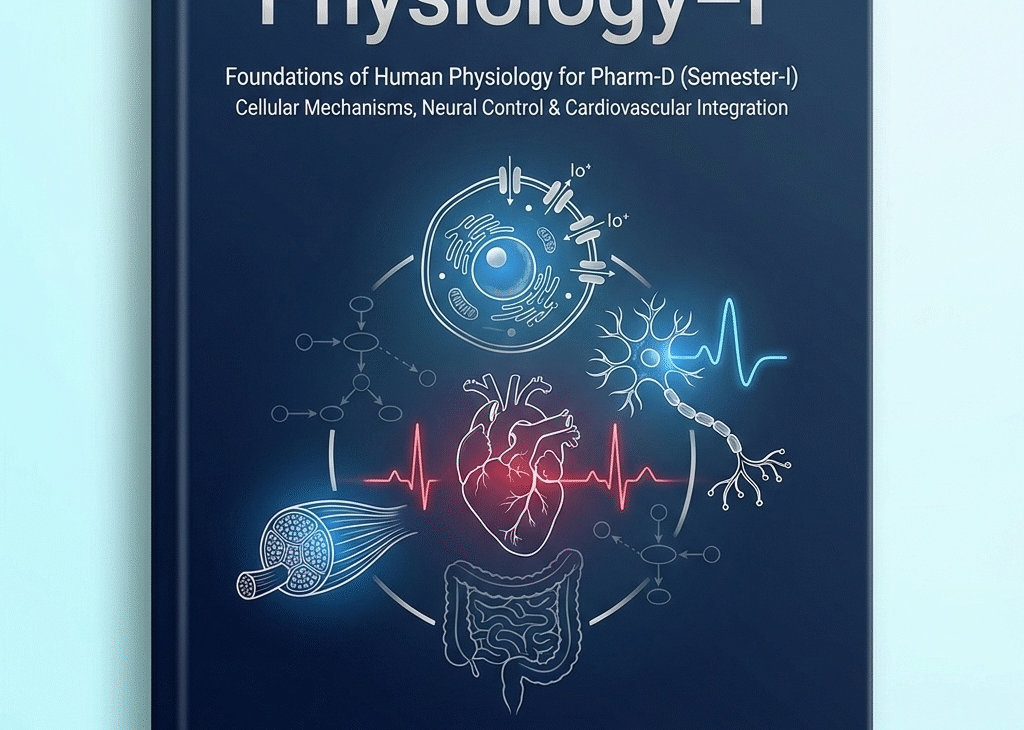

Physiology-I Doctor of Pharmacy – First Semester
The first semester of the Pharm.D program lays a strong foundation in both basic and pharmaceutical sciences, integrating theoretical and practical knowledge essential for future clinical practice.
Theory Subjects:
Physiology-I (PHARMACOLOGY & BASIC MEDICAL SCIENCES)
Course Learning Outcomes:
After completion of this course the students will be able to:
1. Explain the structure and function of cell components, how molecules move across membranes, and key processes like fluid balance, the cell cycle, and apoptosis in maintaining cellular stability.
2. Describe how the nervous system controls body functions, including how neurons work, how action potentials and synapse function, the role of neurotransmitters and sensory receptors, and the structure and function of the central and autonomic nervous systems.
3. Explain the structure and types of skeletal muscles, how they contract, and the role of the neuromuscular junction in muscle activity.
4. Describe the structure and function of the heart, including the cardiac cycle, blood flow, heart sounds, and electrical conduction, and interpret ECG patterns and their clinical relevance.
5. Outline the process of digestion and absorption, including digestive secretions, how they are regulated, and the steps from eating to defecation.
Contents:
The following topics will be taught with special reference to their Pharmaceutical Applications.
1. Basic Cell Functions
(a) Overview of the physical structure of the cell.
(b) Extracellular fluid, intracellular fluid, phagocytosis, pinocytosis, cell cycle, apoptosis, movement of molecules across cell membranes: diffusion, active transport, co-transport, counter-transport, basic principles of osmosis, osmotic pressure and osmotic equilibrium, endocytosis and exocytosis.
2. Neural Control Mechanisms functional classes of neurons, voltage-gated sodium and potassium channels, resting membrane potential, initiation and propagation of action potential, refractory period, all or nothing principle, synapses, types of synapses, physiological anatomy of synapses, excitatory and inhibitory receptors in the postsynaptic membrane, excitatory and inhibitory postsynaptic potentials, classification of sensory receptors, neurotransmitters and neuromodulators.
3. Central Nervous System
Physiological anatomy of brain and spinal cord, blood-brain barrier, functions of cerebrospinal fluid, types of sleep.
4. Autonomic Nervous System
Physiological anatomy of sympathetic and parasympathetic nervous system, pre-ganglionic and post-ganglionic neurons, synthesis and secretion of acetylcholine and nor-epinephrine from nerve terminal, effects of sympathetic and parasympathetic nervous system on various organs of the body, denervation supersensitivity and its mechanism, autonomic reflexes
5. Muscle Physiology
Physiological anatomy of skeletal muscle, types of skeletal muscle fibers, general and molecular mechanisms of muscle contraction, physiological anatomy of neuromuscular junction.
6. The Heart
Physiological anatomy of heart muscle, structure of heart, course of blood flow through heart, the cardiac cycle, conduction system of heart, heart sounds, murmurs, characteristics of normal electrocardiogram, relationship of electrocardiogram to the cardiac cycle, clinical significance of abnormal electrocardiographic patterns. Definitions: (systole, diastole, stroke volume, cardiac output, preload, afterload, ejection fraction).
7. Digestion and Absorption of Food
Gastro-intestinal secretions (salivary secretions, gastric secretions, pancreatic secretions, biliary secretions), nervous and hormonal regulation of gastric secretions, mastication, deglutition, gastric emptying, intestinal movements (peristalsis, segmenting & mixing), biliary enterohepatic circulation, defecation, overview of enteric nervous system.
Curriculum
- 1 Section
- 1 Lesson
- 2000 Days
- Physiology-I (PHARMACOLOGY & BASIC MEDICAL SCIENCES)1
Instructor

Related Courses
 Teacher
Pharmacist Tayyeb Official
Teacher
Pharmacist Tayyeb Official
 Teacher
Pharmacist Tayyeb Official
Teacher
Pharmacist Tayyeb Official
 Teacher
Pharmacist Tayyeb Official
Teacher
Pharmacist Tayyeb Official
 Teacher
Pharmacist Tayyeb Official
Teacher
Pharmacist Tayyeb Official
 Teacher
Pharmacist Tayyeb Official
Teacher
Pharmacist Tayyeb Official
 Teacher
Pharmacist Tayyeb Official
Teacher
Pharmacist Tayyeb Official