
Dispensing Pharmacy (6th Semester of Pharm D) (Written)
- DOCTOR OF PHARMACY (PHARM-D), Pharm-D Semester-VI
- 158 (Registered)
-
(0 Review)
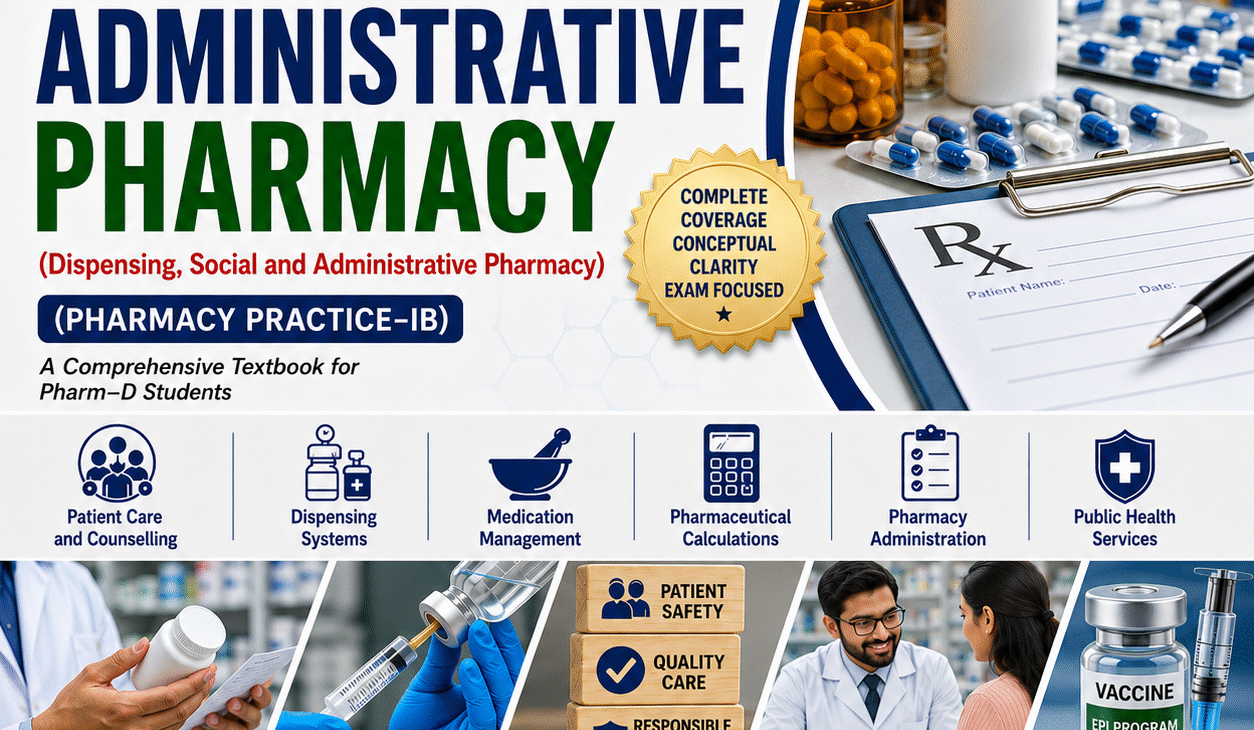

Dispensing, Social and Administrative Pharmacy – 6th Semester
The 6th semester of the Pharm-D program lays a strong foundation in both basic and pharmaceutical sciences, integrating theoretical and practical knowledge essential for future clinical practice.
Theory Subjects:
Course Learning Outcomes:
At the end of the course the student shall be able to:
1. To analyze the structure of pharmacy services within the Pakistani healthcare system, understand the roles of pharmacists in various settings and public health, and apply the minimum standards for hospital and community pharmacy practice.
2. To evaluate medication management and use processes, identify potential risks, propose mitigation strategies based on international best practices.
3. To Apply regulatory requirements to pharmacy operations, develop strategies for formulary management, implement inventory control systems, understand pharmacoeconomic principles, and describe the function of a Pharmacy and Therapeutics Committee.
Contents:
1. Reading and transcribing physicians’ orders, medical profiles and medication administration records
2. Medication cart filling and documentation
3. Recording and management of narcotic drugs
4. Drug Preparation included Aseptic Services in Hospital Pharmacy
a. Fundamental learning of drug preparation and dispensing (Aseptic/ Sterile area
services in hospital settings and compounding services in hospital and community
settings),
b. Pharmaceutical Calculations: Some Fundamentals of Measurements and Calculations. The Metric System. The Common Systems. Conversions. Calculation
of Doses. Percentage calculations, Reducing and Enlarging Formulas. Weights and Volumes of Liquids. HLB Values. Industrial Calculations. Calculations involving
parenteral admixtures. Some calculations involving Hydrogen-ion concentration. Calculations involving isotonic, electrolyte and buffer solutions.
c. Role of pharmacist in radiopharmaceuticals.
d. Drug Administration, follow up and safety procedures in dispensing
5. Basic of drug administration for safe use of medications, including seven rights of drug
administration.
6. Understand the drug devices, drug libraries, and ready to administer mediations
7. Self-administration and home care services.
a. Education for patient, public and health care professionals.
b. Evaluation, promote public health and provide education to the patients, public and
health care providers.
i. Understand the patient’s need, psychology, behavioral sciences and expectations
ii. Development of patient education leaflets, and newsletter.
iii. To provide patient education on safe use of antimicrobials, family planning, etc
iv. Effective medication counselling and drug adherence.
v. Patient feedback / satisfaction survey tools
vi. Drug information services, authentic sources like Lexicomp etc
c. Miscellaneous
d. Drug shortages and liaison with prescribers with the best therapeutic alternatives.
e. Managing Pharmaceutical waste and energy sustainable initiatives in pharmacy services.
f. Drug recalls and response to safety alerts
g. Dispensing of extemporaneous preparations
h. Dispensing of Vaccine, and Biologics: EPI program Pakistan, Essential vaccinations for travelling, Counselling and patient education relevant to Vaccination.
Curriculum
- 1 Section
- 1 Lesson
- 2000 Days
- Dispensing Pharmacy1
Instructor

Related Courses
 Teacher
Pharmacist Tayyeb Official
Teacher
Pharmacist Tayyeb Official
 Teacher
Pharmacist Tayyeb Official
Teacher
Pharmacist Tayyeb Official
 Teacher
Pharmacist Tayyeb Official
Teacher
Pharmacist Tayyeb Official
 Teacher
Pharmacist Tayyeb Official
Teacher
Pharmacist Tayyeb Official
 Teacher
Pharmacist Tayyeb Official
Teacher
Pharmacist Tayyeb Official
 Teacher
Pharmacist Tayyeb Official
Teacher
Pharmacist Tayyeb Official