
Pharmacology & Therapeutics-IA (3rd Semester of Pharm D) (Written)
- DOCTOR OF PHARMACY (PHARM-D), Pharm-D Semester-III
- 192 (Registered)
-
(0 Review)
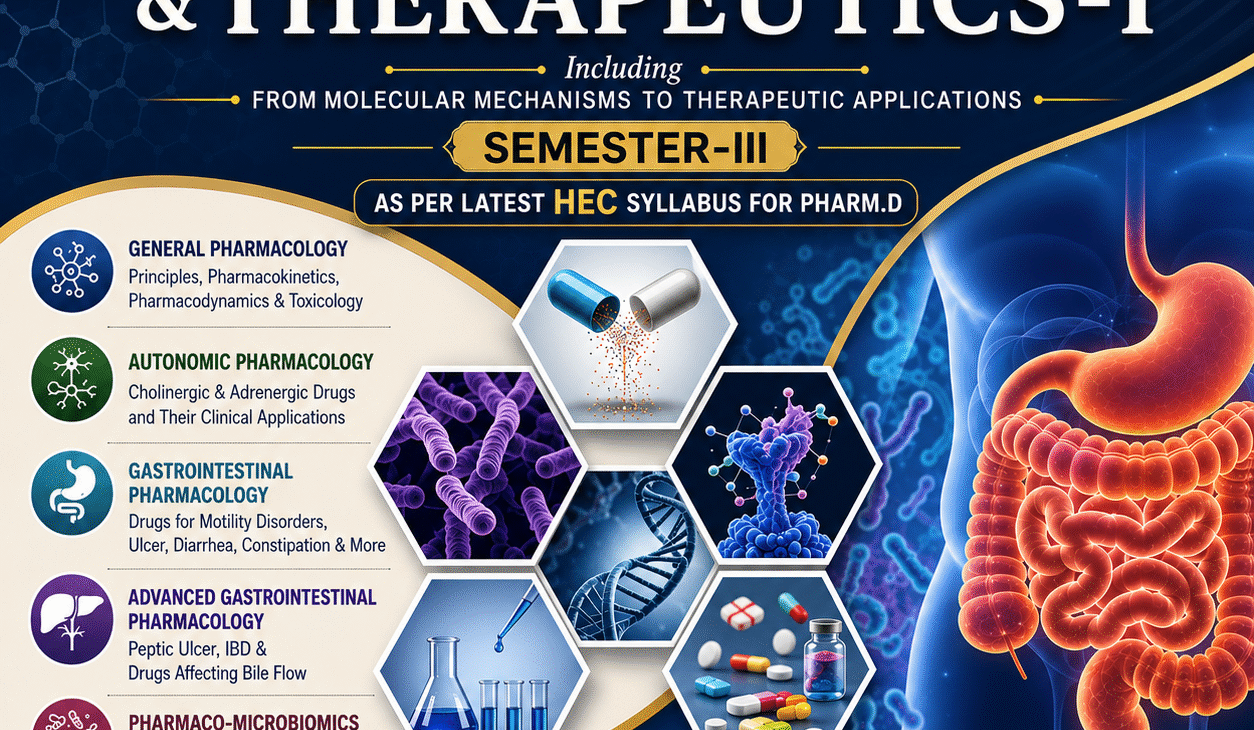

Pharmacology & Therapeutics-I – 3rd Semester
The 3rd semester of the Pharm-D program lays a strong foundation in both basic and pharmaceutical sciences, integrating theoretical and practical knowledge essential for future clinical practice.
Theory Subjects:
After completion of this course the students will be able to:
Course Learning Outcomes:
At the end of this course the student will be able to:
1. Analyze fundamental principles of General Pharmacology, including pharmacokinetic and pharmacodynamic parameters, and apply this understanding to evaluate individual drug pharmacology.
2. Classify molecular drug targets including receptor types, secondary messengers, and signaling pathways, and demonstrate their therapeutic implications through specific drug examples.
3. Evaluate pharmacological mechanisms of autonomic nervous system drugs and justify their clinical applications in professional healthcare scenarios.
4. Demonstrate comprehensive knowledge of gastrointestinal drug pharmacology and implement this understanding in appropriate clinical decision-making contexts.
5. Explore the emerging field of pharmacomicrobiomics and its potential impact on personalized therapeutics, focusing on how gut microbiota can influence drug metabolism and therapeutic outcomes.
Course Content:
1. General Pharmacology
a) Introduction to Pharmacology. Historical milestones in pharmacology, Drug sources.
b) Routes of drug administration, advantages and disadvantages
c) Pharmacokinetics: Absorption (Mechanism/membrane permeability, bioavailability), distribution (mechanism, volume of distribution (Vd), plasma protein binding), metabolism (phase 1 and phase II reactions, enzyme induction/inhibition) and elimination (clearance (Cl), half-life) of drugs along with factors affecting them.
d) Pharmacodynamics: Drug receptor interactions (Agonist, antagonist, partial agonist, inverse agonist). Receptor internalization and receptors co-localization. Definitions: Spare receptors, orphan receptors, Median lethal dose (LD50), Median effective dose (ED50), and Therapeutic
Index. Efficacy vs Potency, drug tolerance and dependence, dose-response relationships.
2. Molecular And Cellular Pharmacology
a) Types of receptors: (Ligand-gated and voltage-gated ion channels, G-protein coupled receptors, Enzyme-linked receptors, and nuclear receptors).
b) Secondary messengers
c) Signaling pathways as drug targets: Nuclear Factor Kappa B (NF-κB) pathway, P53 pathway, Peroxisome proliferator-activated receptor (PPAR) pathway, Glucagon-Like Peptide-1 (GLP
1) Pathway, JAK-STAT pathway, PI3K-Akt-mTOR Pathway, MAPK/ERK Pathway.
3. Drugs Acting on Autonomic Nervous System (ANS):
a) Sympathetic agonists and antagonists
b) Parasympathetic agonists (Direct and indirect acting), and antagonists
c) Ganglion stimulants and Ganglion blockers
d) Neuromuscular Blockers
4. Drugs Acting on Gastrointestinal Tract:
a) Emetic and anti-emetics
b) Laxatives, cathartics, and constipation therapy
c) Anti-diarrheal agents
d) Treatment of Peptic & duodenal ulcer
e) Drug treatment of chronic inflammatory bowel diseases
f) Drugs affecting bile flow and Cholelithiasis
5. Pharmaco-microbiomics
a) Introduction to pharmaco-microbiomics and relationship with precision medicine
Curriculum
- 1 Section
- 1 Lesson
- 365 Days
- Pharmacology & Therapeutics-1A1
Instructor

Related Courses
 Teacher
Pharmacist Tayyeb Official
Teacher
Pharmacist Tayyeb Official
 Teacher
Pharmacist Tayyeb Official
Teacher
Pharmacist Tayyeb Official
 Teacher
Pharmacist Tayyeb Official
Teacher
Pharmacist Tayyeb Official
 Teacher
Pharmacist Tayyeb Official
Teacher
Pharmacist Tayyeb Official
 Teacher
Pharmacist Tayyeb Official
Teacher
Pharmacist Tayyeb Official
 Teacher
Pharmacist Tayyeb Official
Teacher
Pharmacist Tayyeb Official