
Physiology-II (2nd Semester of Pharm D) (Written)
- DOCTOR OF PHARMACY (PHARM-D), Pharm-D Semester-II
- 139 (Registered)
-
(0 Review)
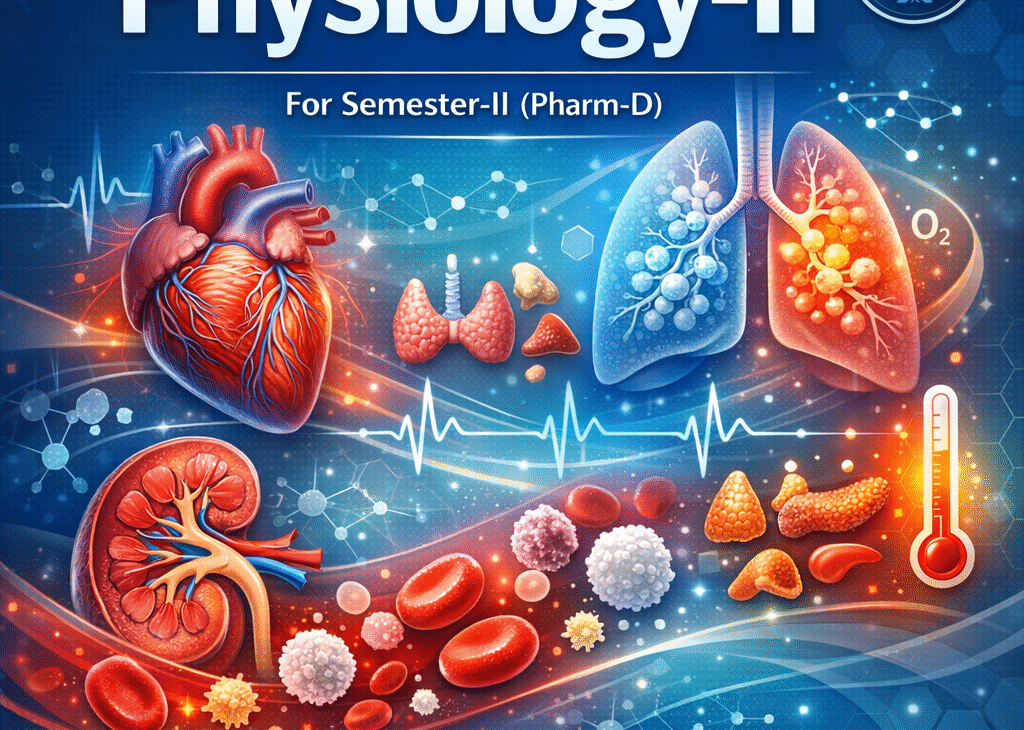

Physiology – 2nd Semester
The 2nd semester of the Pharm-D program lays a strong foundation in both basic and pharmaceutical sciences, integrating theoretical and practical knowledge essential for future clinical practice.
Theory Subjects:
Course Learning Outcomes:
At the end of this course the student will be able to:
1. Explain the structure, formation, and functions of blood components, describe the process of blood clotting and blood typing, and relate these to common disorders like anemia and leukopenia.
2. Describe the structure and function of the circulatory and lymphatic systems, including blood vessels, and explain how blood pressure is regulated.
3. Explain how the respiratory system works, including gas exchange, breathing control, and the different lung volumes and capacities.
4. Describe kidney function and urine formation, and explain how the body maintains fluid, electrolyte, and acid-base balance.
5. Explain the physiology of the male and female reproductive systems, including gamete formation, the menstrual cycle, and stages such as puberty, pregnancy, and menopause.
Contents
1. The Blood Cells
Red blood cells, erythropoiesis, formation and destruction of hemoglobin, types of white blood cells, genesis of white blood cells, roles of different white blood cells, types of T-cells and their functions, B-cells and memory cells, antibodies, formation of pus, anemia and leukopenia, platelets, formation of platelet plug, mechanism of blood coagulation, extrinsic and intrinsic pathways of initiating clotting, lysis of blood clot, blood types, agglutinogens, Rh blood types, plasma, serum.
2. Circulation
Basic theory of circulatory function, structure and function of blood vessels (arteries, arterioles, capillaries, veins), blood pressure, total peripheral vascular resistance and total pulmonary vascular resistance, clinical methods of measuring systolic and diastolic blood pressures, arterial pressure and baroreceptor reflex, renin-angiotensin system, hematocrit, lymph channels of the body, formation of lymph.
3. Respiratory Physiology
Physiological anatomy of lungs, mechanism of inspiration and expiration, definitions of various lung volumes and capacities, exchange of gases in alveoli and tissues, transport of oxygen in blood, transport of carbon dioxide in Blood, transport of hydrogen ions between tissues and lungs, regulation of respiration, pulmonary edema, pleural effusion, non-respiratory functions of the Lungs.
4. Renal Physiology
Physiological anatomy of kidney and nephron, Functions of the kidney, Urine formation, glomerular filtration, glomerular filtration rate (GFR), mechanisms of tubular reabsorption and secretion, formation of dilute and concentrated urine, micturition, buffering of H+ ion, renal sodium regulation, renal potassium regulation, renal water regulation.
5. Endocrine and Reproductive Physiology
Physiological roles of hormones secreted from major endocrine glands (pituitary, thyroid, adrenal, and pancreas), along with reproductive physiology including gametogenesis, menstrual cycle regulation, and life-stage transitions.
6. Temperature Regulation
Mechanisms of body temperature regulation and pathophysiology fever and hypothermia.
Curriculum
- 1 Section
- 1 Lesson
- 365 Days
- Physiology-II1 Item
Instructor

Related Courses
 Teacher
Pharmacist Tayyeb Official
Teacher
Pharmacist Tayyeb Official
 Teacher
Pharmacist Tayyeb Official
Teacher
Pharmacist Tayyeb Official
 Teacher
Pharmacist Tayyeb Official
Teacher
Pharmacist Tayyeb Official
 Teacher
Pharmacist Tayyeb Official
Teacher
Pharmacist Tayyeb Official
 Teacher
Pharmacist Tayyeb Official
Teacher
Pharmacist Tayyeb Official
 Teacher
Pharmacist Tayyeb Official
Teacher
Pharmacist Tayyeb Official